Cost of goods sold (COGS) is what the products you sold cost you. For an Amazon seller, that’s the price you paid your supplier plus the cost of getting each unit into Amazon’s warehouses.
Get it right and you know your real margin on every SKU. Get it wrong and your profit, and your tax bill, are wrong too.
This guide covers the formula, what Amazon sellers should and shouldn’t include, the IRS inventory rules and how to record COGS in your books. If you want a number right now, use our COGS calculator.
This is general information, not tax advice. Your tax preparer should confirm the inventory method you use.
The cost of goods sold formula
For a period such as a month or a year:
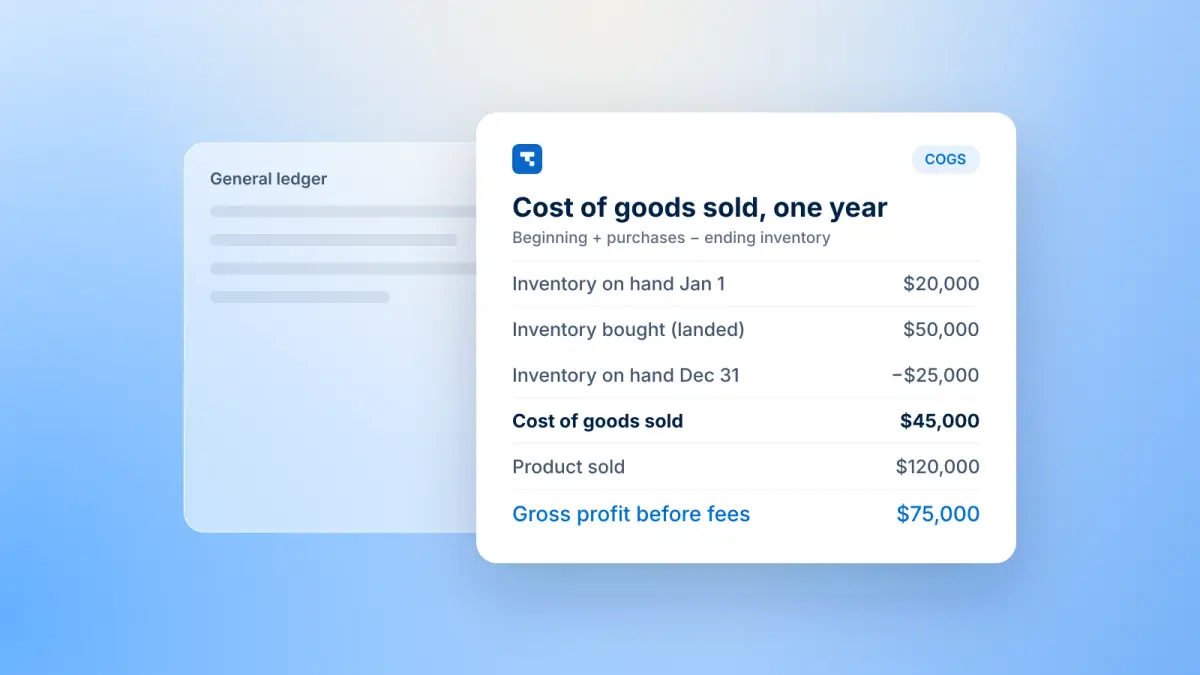
Beginning inventory + Purchases − Ending inventory = Cost of goods sold
Example for one year:
| Amount | |
|---|---|
| Inventory on hand January 1 (at cost) | $20,000 |
| Inventory bought during the year, landed | $50,000 |
| Inventory on hand December 31 (at cost) | −$25,000 |
| Cost of goods sold | $45,000 |
If you sold $120,000 of product that year, your gross profit before Amazon fees is $75,000.
Ending inventory includes stock in Amazon fulfillment centers, stock in transit and stock at your own warehouse or 3PL. Amazon’s inventory reports in Amazon Seller Central show what’s in FBA; you add the rest.
What goes into the cost of a unit
Use the landed cost: everything you paid to get a unit ready to sell.
- Product cost from your supplier or manufacturer
- Freight from the factory to your warehouse or to Amazon
- Customs duties, tariffs and broker fees
- Inbound shipping and placement fees to send stock to Amazon
- Prep, labeling and packaging done before the item is sold
Spread shared costs, such as one freight bill for a mixed shipment, across the units in that shipment. Our landed cost calculator does the split.
What usually stays out of COGS
These are real costs, but most accountants record them as operating expenses instead:
- Amazon referral fees and FBA fulfillment fees, charged when a unit sells. See our Amazon seller fees guide for current rates.
- Monthly storage fees and long-term storage fees
- Advertising, including Sponsored Products
- Software, subscriptions and your own salary
Keeping them separate lets you see two different numbers: what the product costs you (gross margin) and what it costs to sell on Amazon (operating costs). Some sellers include FBA fulfillment fees in a management-only “contribution margin” view, which is fine as long as your tax books stay consistent.
Choosing an inventory method
You need a way to decide which units’ cost goes to COGS when costs change between orders.
- FIFO (first in, first out): the oldest units are sold first. Most common for small sellers and the easiest to explain.
- Weighted average cost: each SKU carries an average cost that updates with every purchase. Simple when a SKU is restocked often at slightly different prices.
- Specific identification: you track the exact cost of each unit. Practical only for high-value, serialized items.
- LIFO (last in, first out): allowed for US taxes but rare for small sellers, and it comes with extra rules.
Pick one with your tax preparer and use it consistently. Changing your inventory method generally needs IRS approval. IRS Publication 538 covers inventory methods in detail.
Simpler rules for small sellers
Businesses with average annual gross receipts of $32 million or less over the prior three years (the threshold for tax years beginning in 2026) count as small business taxpayers. They can:
- Skip the uniform capitalization rules that make larger businesses add overhead to inventory cost
- Use a simpler inventory method, such as treating inventory as non-incidental materials and supplies, or following the method used in their own books
Most Amazon sellers fall under this threshold. The simpler methods still don’t mean you deduct stock when you buy it. Talk to your tax preparer before you change anything.
Amazon-specific COGS situations
- Customer returns. A unit returned in sellable condition goes back into inventory, so its cost should come back out of COGS. An unsellable return stays in COGS (or goes to an inventory write-off).
- Lost or damaged FBA inventory. Write off the cost. If Amazon reimburses you, record the reimbursement as income or against the write-off, not as a sale.
- Removals and disposals. Units Amazon disposes of are written off at cost. Units you have removed go back into your own inventory.
- Bundles and multi-packs. Give the bundle SKU the combined cost of its parts.
How to record COGS in your books
The cleanest way is to move cost out of inventory as units sell:
- Inventory (an asset account) goes up when you buy stock.
- Cost of goods sold (an expense account) goes up, and inventory goes down, as units sell.
Doing this monthly, or per Amazon settlement, keeps your gross margin accurate all year. For the accounts and the journal entry step by step, see how to record Amazon FBA COGS in QuickBooks Online. Doing it once at year end means every monthly profit-and-loss report until then overstates your profit.
Taxomate handles this for Amazon sellers. You enter a unit cost for each SKU, and for each settlement Taxomate posts a summarized COGS entry to QuickBooks Online, Xero or Wave, alongside the sales, fees and refunds from the same settlement. See the Amazon QuickBooks integration or Amazon Xero integration, or read our Amazon seller accounting guide for how COGS fits into the rest of your books.
Disclaimer: This article is general information provided in good faith. It is not tax or legal advice. Talk to a qualified tax professional or CPA about your own situation.


